How ancient builders made the Great Pyramid of Giza nearly earthquake-proof
A new study measuring vibration frequencies throughout the Great Pyramid revealed how it has been able to withstand severe seismic shocks.
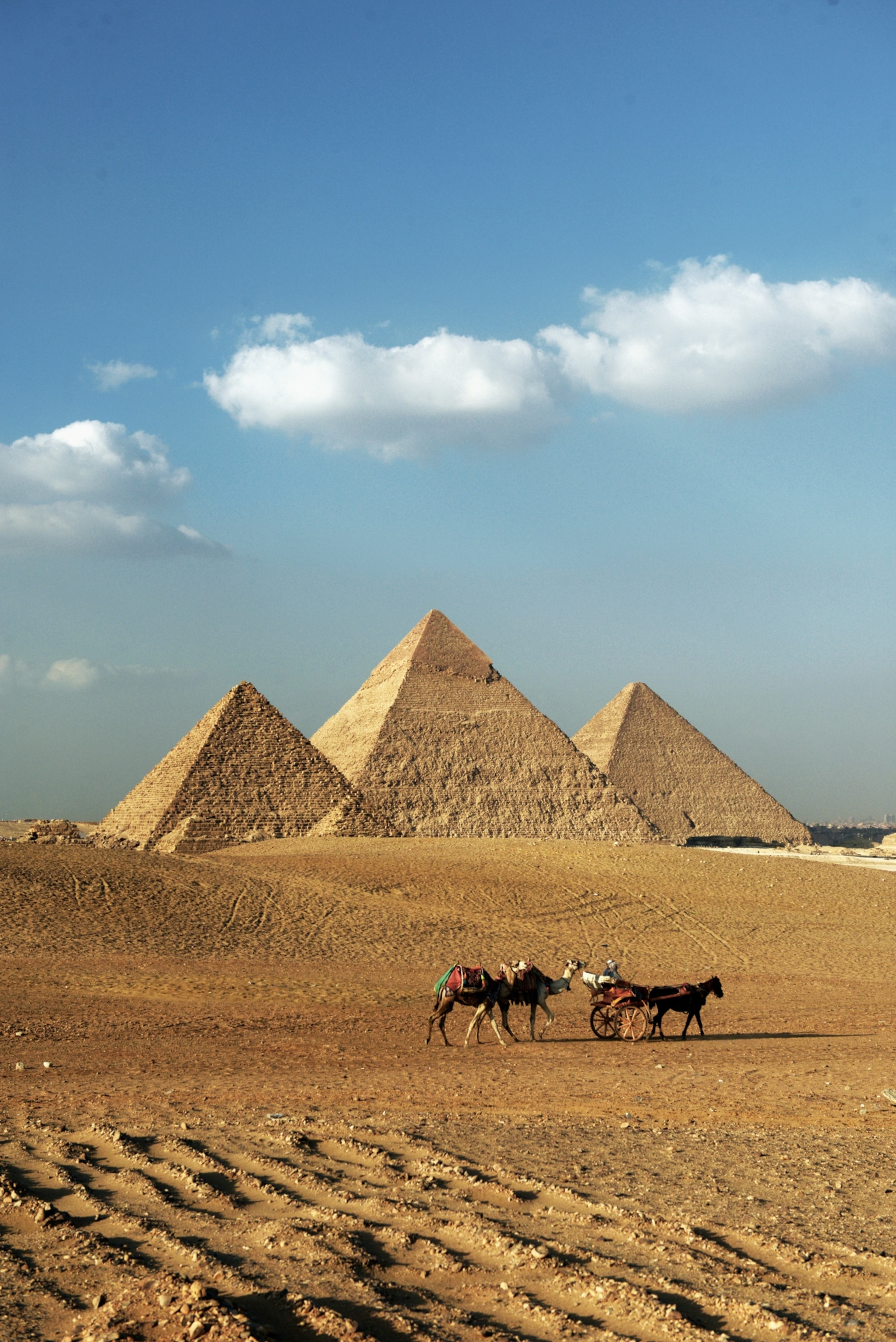
Around 2500 B.C., Egypt’s great pharaoh Khufu began a massive construction project.
His goal was to erect a large pyramid on the Giza Plateau, which would later serve as his tomb, alongside a series of smaller pyramids for his wives. For 26 years, thousands of laborers hauled and stacked over 2.3 million limestone and granite blocks to create the 481-foot-tall monument. For millennia, the architectural marvel would endure the ravages of time.
Now, scientists have found that Khufu’s Great Pyramid was well-structured to withstand another kind of scourge: earthquakes.
In a study published Thursday, researchers from Egypt and Japan gathered resonance data, or vibrating waves, from nearly 40 different areas within and around the Great Pyramid to see how the monument responded to seismic activity. They found that the structure has a remarkable ability to disperse seismic vibrations, giving it a rock-solid response to otherwise destructive quakes.The data indicate the pyramid was “intelligently balanced and well-tuned” for stability, says Asem Mostafa, a seismologist at the National Research Institute of Astronomy and Geophysics (NRIAG) in Cairo, and an author of the study.
(How a one-of-a-kind robot led researchers deep into the Great Pyramid)
Over the pyramid’s 4,600-year-long history, it has survived numerous earthquakes that have decimated nearby buildings. The findings, which were published in the journal Scientific Reports, add a new dimension to the already staggering ingenuity of ancient Egyptian engineers. While the research shows the builders' impressive abilities, the researchers state that they cannot say for certain whether their techniques were used with earthquakes in mind.
“We see this as the culmination of centuries of Egyptian builders learning from both successes and failures,” says Mostafa. “It felt like uncovering a masterpiece of empirical engineering that had been hiding in plain sight for thousands of years.”
Enduring Egypt’s earthquakes
Egypt is no stranger to seismic activity. Over the past few centuries, a handful of earthquakes have struck near Cairo with calamitous consequences. In October 1992, a magnitude 5.9 earthquake struck about 20 miles southwest of Cairo, devastating the plateau. It damaged or destroyed more than 129,000 buildings, including over one-third of the local houses. Many ancient mosques suffered cracks in marble structures. Tombs in the Valley of the Kings were damaged enough to require new bracing for internal support.
But only one stone fell from Khufu’s pyramid, according to Mohamed ElGabry, a seismologist also at NRIAG and lead author of the study.
“Ancient structures, built with massive, well-interlocked stone blocks, generally suffered far less damage than later era monuments,” ElGabry says.
Many of the Great Pyramid's advanced architectural features were already known to researchers, he adds. The monument is widest at its base, which spans over 755 feet, providing structural integrity that prevents it from toppling easily. It is also highly symmetrical and utilizes a firm bedrock foundation.
“The fact that it is structurally resilient was never in doubt,” adds Mostafa.
Much of the ingenuity came from a history of pyramid-building innovations. Earlier structures were built in the city of Saqqara, which is around 19 miles south of Cairo. The Pyramid of Djoser—also called the Step Pyramid—is the oldest of these and preceded the Great Pyramid by over a century. It has a different external shape from Khufu’s pyramids, rising in a chunky, stepwise fashion rather than a continuous slope as at the Giza Pyramids.
The pharaoh Sneferu, Khufu’s likely father, who ruled from 2613 to 2589 B.C., later built large pyramids that pioneered the smooth-sided shape of the Giza Pyramids. Ancient Egyptians continued to build pyramids long after Khufu’s death in 2566 B.C. While some of these pyramids utilized the same structural plans as his, others tried to cut costs.
(Making sense of the pyramids’ enduring mysteries)
Khufu’s son and successor, Djedefre, built a pyramid north of Cairo that partially utilized a hill to increase its prominence. The embedded monument minimized interlocking blocks, reducing its stability. The so-called “Black Pyramid,” built by Amenemhat III several centuries later, was constructed primarily of mud-brick, which was cheaper and more prone to deterioration than solid limestone blocks. The weaker base material led to their more rapid degradation due to erosion and aging. Unlike the Pyramid of Khufu, some of these structures have since collapsed completely.
Pyramid in sync
During their examination of the Great Pyramid of Giza, the seismologists measured vibration frequencies within its internal chambers and tunnels, including the King’s Chamber, Queen’s Chamber, relieving chambers, and Subterranean Chamber. They used a non-destructive technique called “ambient vibration analysis” that allowed them to measure how vibrations channel through the different blocks, tunnels, and internal cavities. The data would help them clarify how the structure responds to earthquakes.
Their results showed that the overall resonance throughout the structure averages between 2 and 2.6 hertz, indicating that vibrations reverberate evenly from stone to stone—a key sign of stability. The analysis also found that the vibrations differ from those in the soil surrounding the pyramid, which are around .6 hertz.
"The dominant vibration frequencies of the pyramid differ significantly from those of the surrounding soil, which likely reduces resonance effects during earthquakes,” says Mostafa. By reducing the resonance, the destructive potential of violent vibrations in the earth is minimized.
Ahmed Eldosouky, a geophysicist at Suez University in Egypt who was not involved with the research, agrees.
“The measurements across many internal parts of the pyramid showed relatively consistent fundamental frequencies,” Eldosouky says. “That level of dynamic homogeneity suggests a remarkably stable structural system, especially considering the monument’s age and construction period.”
(The mummy, the Iliad, and a mysterious death ritual)
The researchers also found that the relieving chambers helped reduce destructive frequencies in the King’s Chamber, which lies directly below them. The frequencies decreased in these chambers, which helps settle seismic activity around the precious King’s Chamber and helps prevent the structure from sustaining damage in the event of an earthquake.
According to Mostafa, the new discovery shows that ancient Egyptian builders developed highly effective construction practices over generations of careful observation and refinement. "Their achievements remain extraordinary even when examined using modern scientific tools," he says
Comments
Post a Comment