
Translate

How a bear claw became a grisly token of Arctic survival


How a bear claw became a grisly token of Arctic survival


Over a century ago, a team of researchers set out to establish the first research station on Canada’s Ellesmere Island. Then tragedy struck.
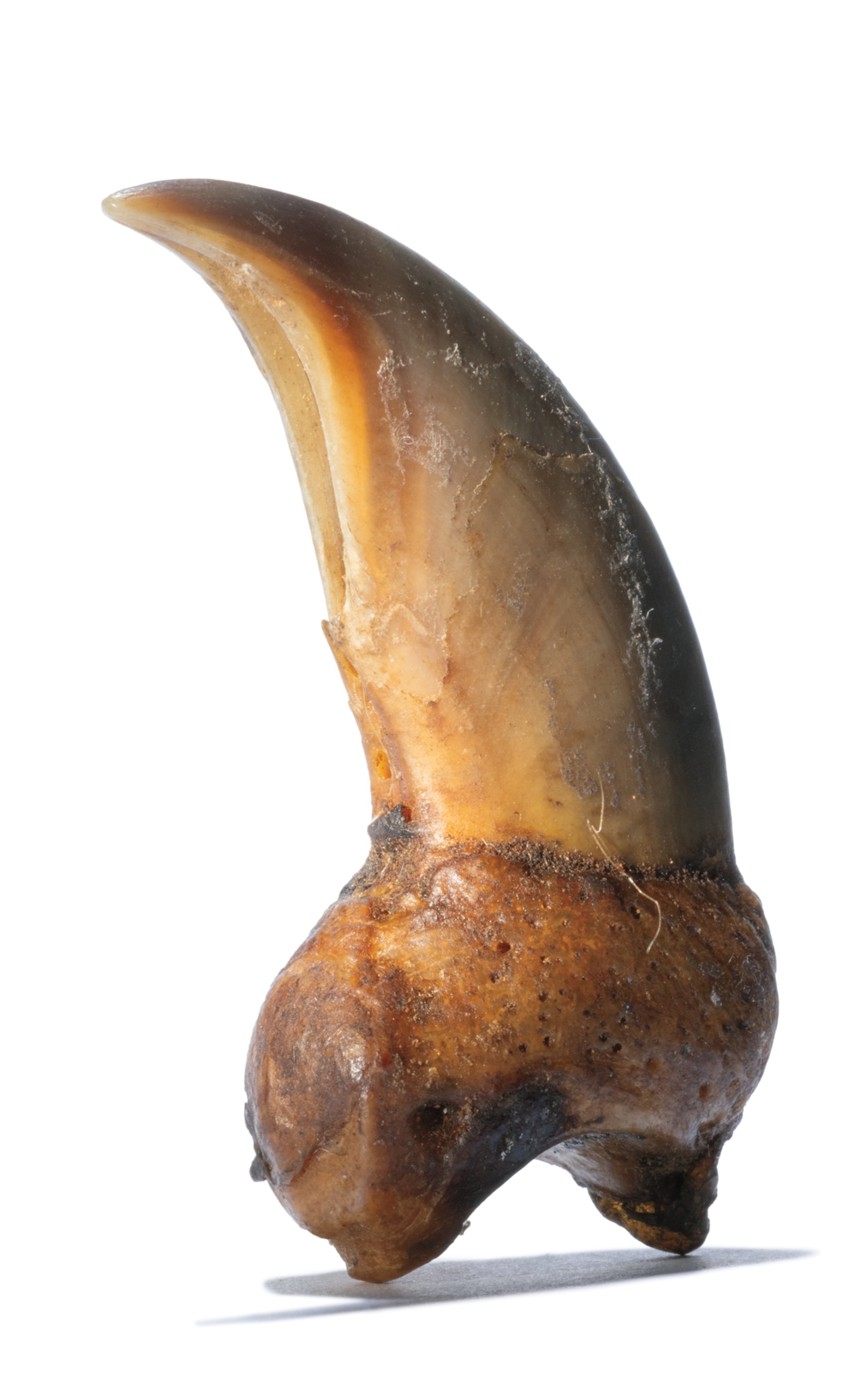
A single bear claw looking like an animal tusk.
A typewritten object label accompanying this claw in the National Geographic archive gives the date that the bear it belonged to was shot: April 11, 1884. "Many members of the expedition had already died from starvation at this time," it reads.Rebecca Hale, National Geographic
ByRachel SladePublished July 9, 2026

As large as a human finger and as sharp as a needle—that’s how one descendant of Adolphus Greely describes a claw from the bear that saved his great-great-granddad’s life. In 1881, seven years before Greely became a founding member of the National Geographic Society, the Army lieutenant set out with two dozen men to establish an Arctic research station on the far northern reaches of Canada’s Ellesmere Island.

Greely’s was one of many American and European camps created that year, all tasked with meticulously recording Arctic data—temperature, wind speed, magnetic changes, barometric pressure. The international project’s ambitious goal: to unlock the mystery of Earth’s weather patterns.

Woefully underfunded by Congress and green-lit too late for proper preparation, the expedition got off to a shaky start. Greely himself landed the command not for his expertise so much as his enthusiasm—he had read voraciously about the Arctic but had never set foot there. Once appointed, he hastily assembled a crew and supplies, then raced north in early July to build a camp fewer than 500 miles from the North Pole before winter’s grip tightened.

A steamship deposited Greely and his men, who built their station and survived the long, dark winter. But the ship to retrieve them the next summer never came.

Unknown to Greely, pack ice had choked a crucial channel, blocking resupply efforts. By August 1882, Greely and his men, crestfallen and homesick, braced for another Arctic winter.

The following June, two supply ships tried to fight their way through the ice. One retreated, and the second was crushed. With no relief in sight, Greely made the call in August 1883 to abandon the station and row south in small open boats to search for a supply cache—or a rescue ship.

Portaging heavy boats across ice floes, dodging towering bergs, and rowing with frostbitten fingers, the men at last reached their destination. Instead of abundant supplies, though, they found scraps, barely enough to survive 40 days. The men scraped by on small game, Arctic shrimp, and lichen they clawed from the rocks.

Then, in April 1884, two emaciated men shot a polar bear. That extreme measure kept Greely and six others alive until a rescue ship—equipped with dynamite to blast through the ice—finally arrived in June.

Greely spirited back at least two bear claws. One remains with his descendants. This claw has long been in the National Geographic archives. “Except for this kill,” reads a timeworn label accompanying the trophy, “none of the party would have returned alive.”

Comments

Popular posts from this blog

Dorothy Arnold: The missing heiress at the center of New York’s oldest cold case

Dorothy Arnold: The missing heiress at the center of New York’s oldest cold case 10 Minutes Read 2072 Words EN Premium HISTORY & CULTURE Dorothy Arnold’s family speaks out about her disappearance, more than a hundred years ago. New York City heiress Dorothy Arnold's mysterious disappearance more than a century ago set off a media frenzy—particularly as surprising details about her unconventional life emerged. Was she abducted or killed—or did she run away? The cold case remains a subject of fascination. Photograph by Fay 2018, Alamy By Rosemary Counter Last updated August 7, 2025 Dorothy Arnold’s disappearance has enthralled people ever since she vanished on December 12, 1910. On that icy Monday morning, the 25-year-old socialite left her Upper East Side mansion to go dress shopping for her little sister Marjorie’s upcoming debutante ball. She told a friend she was shopping with her mother, and told her mother she’d rather shop alone. The eldest daughter of the high-society Ar...

The Maya people, history, achievements, and decline

The Maya people, history, achievements, and decline 7 Minutes Read 1554 Words EN HISTORY & CULTURE The pyramid-building Maya reigned over much of Central America. Today, descendants keep Maya history alive—a sign of resilience. This sculpture of the head of a Mayan warrior found in the Temple of the Inscriptions at Palenque, Mexico. One of the largest and best-preserved Mayan pyramids, the temple was a mausoleum for 7th century ruler K’inich Janab Pakal. De Agostini via Getty Images By Erin Blakemore Last updated October 9, 2025 Evidence of Mayan civilization was everywhere: Beneath a Spanish convent, underneath a street. Most of it was covered in vines and vegetation, reclaimed by the jungle. The British-American explorers combing through the Yucatán Peninsula in the 1830s and 1840s had no idea who built these mysterious sites but soon became convinced that they were major archaeological treasures. Discarded and abandoned, the function of these sites and artifacts—temples, pyramid...

The Brutal Murders of Kathleen Henry and Veronica Abouchuk

In September 2019, a woman named Valerie Casler stole Brian Steven Smith's cell phone  from his truck in Anchorage, Alaska. When Casler charged the phone, she made a horrifying discovery - it contained graphic videos and photos depicting the murder of 30-year-old Alaska Native woman Kathleen Jo Henry. The footage showed Henry being beaten, râped, and strangled to death in an Anchorage hotel room. Casler transferred the disturbing content to an SD card, labeled it "Homicide at Midtown Marriott", and turned it over to the police; there were 39 photos and 12 videos on the card. Two days after the card was given to the Authorities, someone called 911 to report that they had seen a human remains close to the Seward Highway in the southern part of Anchorage. The Detectives were able to trace the location of Smith's phone to the area where the remains were found. The deceased was later identified as Kathleen Jo Henry. Brian was arrested at the Ted Stevens Anchorage Internati...