- HISTORY & CULTURE
From a curious Midwestern girl to a legendary aviator, Amelia Earhart's life was a daring pursuit of freedom, flight, and self-definition.

When Amelia Earhart stepped into the cockpit of her Lockheed Electra in June 1937, her sights were set on an accomplishment no woman had ever made—a female-piloted solo flight around the globe.

Newspaper reporters crowded around the plane, documenting everything from her blue eyes to her bobbed hair to her pre-flight banter about her airplane’s fuel capacity and speed. Though many of the reporters asked about the potential danger of her trip, she shrugged off their questions. “It is to be a safe and sane flight along scheduled airlines,” she assured them—a 27,000 mile journey that would take her to five continents.
The lauded female flyer would never complete the ambitious task. She and her plane disappeared later that month, and the details of her final resting place remain one of the greatest unsolved mysteries of modern times. But the flying pioneer is remembered for more than her mysterious end.
Here’s how Amelia Earhart changed flight forever as history’s best-known female aviator.
Amelia Earhart’s adventurous childhood
Born in Atchison, Kansas, in 1897 to Edwin and Amy Earhart, Amelia Mary Earhart was the oldest of two daughters. Her father had risen from a modest background to a career as an attorney, and her mother was part of a socially prominent local family that prioritized education and philanthropy.
Amy was an adventurer herself, solo climbing a Colorado mountain as a young woman, and some family histories claim she was denied a college education by her traditional father. Amy didn’t want that fate for her daughters. “I advocate for every girl training along some line so she has something she can do to support herself,” Amy wrote in 1944.
And so Amy’s girls flouted convention at a young age by wearing bloomers instead of skirts as they played sports outside. “Unfortunately I lived at a time when girls were still girls,” Earhart later wrote in her 1932 autobiography, remembering that she and her sisters were seen as anomalies for their energetic athleticism and interest in a world beyond Kansas.
The world the girls grew up in was deeply conflicted about women’s growing social roles. Women’s rights were rapidly expanding, and women would gain the right to vote during Amelia’s twenties. But many Americans were skeptical of women’s growing participation in realms they considered “unladylike”—public places once reserved for men only.
Instead of prioritizing marriage and childbirth, Amelia wanted a career and freedom. But options were limited so Earhart went into service work, first as a nurse’s aide in a Canadian military hospital during World War I, then as a social worker in 1925.


Amelia Earhart takes flight
Social work was considered a respectable career for a woman at the time. But Earhart had another, less socially acceptable passion on the side—aviation. She had grown up alongside the fledgling field, which exploded after the Wright Brothers’ successful first flight in 1903. Amelia saw her first airplane at a fair in 1907—and the ten-year-old was unimpressed by what she saw as a rusty, uninteresting contraption.
That changed in 1920, when the college student attended an “air rodeo” in Long Beach, California, with her father. Such events were common amusements in the early 1920s, and usually featured daredevil former flying aces showing off the skills they had honed in combat. The day after the event, Amelia was a passenger on a 10-minute flight with barnstormer Frank Hawks.
The plane only rose 2,000 feet, but it swept Amelia off hers. “As soon as we left the ground, I knew I myself had to fly,” she later recalled. She begged her parents to allow her to take flight lessons, and arranged for one of the few women in the field, test pilot Neta Snook, to instruct her. In 1923, she was licensed by the governing body of sports aviation, the Fédération Aéronautique Internationale—the 16th woman to gain the coveted license.
Earhart’s rising fame and record-breaking flights
Plagued with both financial and health issues during her early 20s, Earhart took odd jobs to finance her flight education and buy her first plane. She also became involved in her local chapter of the National Aeronautical Association. “None of this was what you could call important—except to me,” she later wrote in her 1932 autobiography. “It was sheer fun.”
Then, in 1928, Earhart was asked if she wanted to become the first woman to cross the Atlantic Ocean by plane. The dangerous crossing was undertaken by pilot Wilmer Stultz and a copilot Louis Gordon, both of whom were compensated for the flight. By contrast, Earhart would be an unpaid passenger.
“She was invited on board to represent the liberated, yet still feminine, all-American girl—an educated, socially-gracious woman comfortable with modern technology,” writes historian Amy Sue Bix.
Earhart wanted to fly the plane during the crossing, but poor visibility and pilot decisions meant that she did not spend time behind the rudder. But the stunt was historic nonetheless. Suddenly, Amelia Earhart was a household name.
How ‘Lady Lindy’ took the world by storm
Earhart used her sudden celebrity to aviation’s advantage. Meeting with celebrities, she used their endorsements and connections to finance future flights. She helped popularize the idea of women in aviation through writing about her experiences for national publications. She even set fashions, including a velvet, turban-style hat inspired by her leather flying helmet that was advertised as, ”smart for traveling by train or motor, as well as for flying.” Earhart continued to fly, earning records for altitude and becoming the first woman to fly solo across the United States.
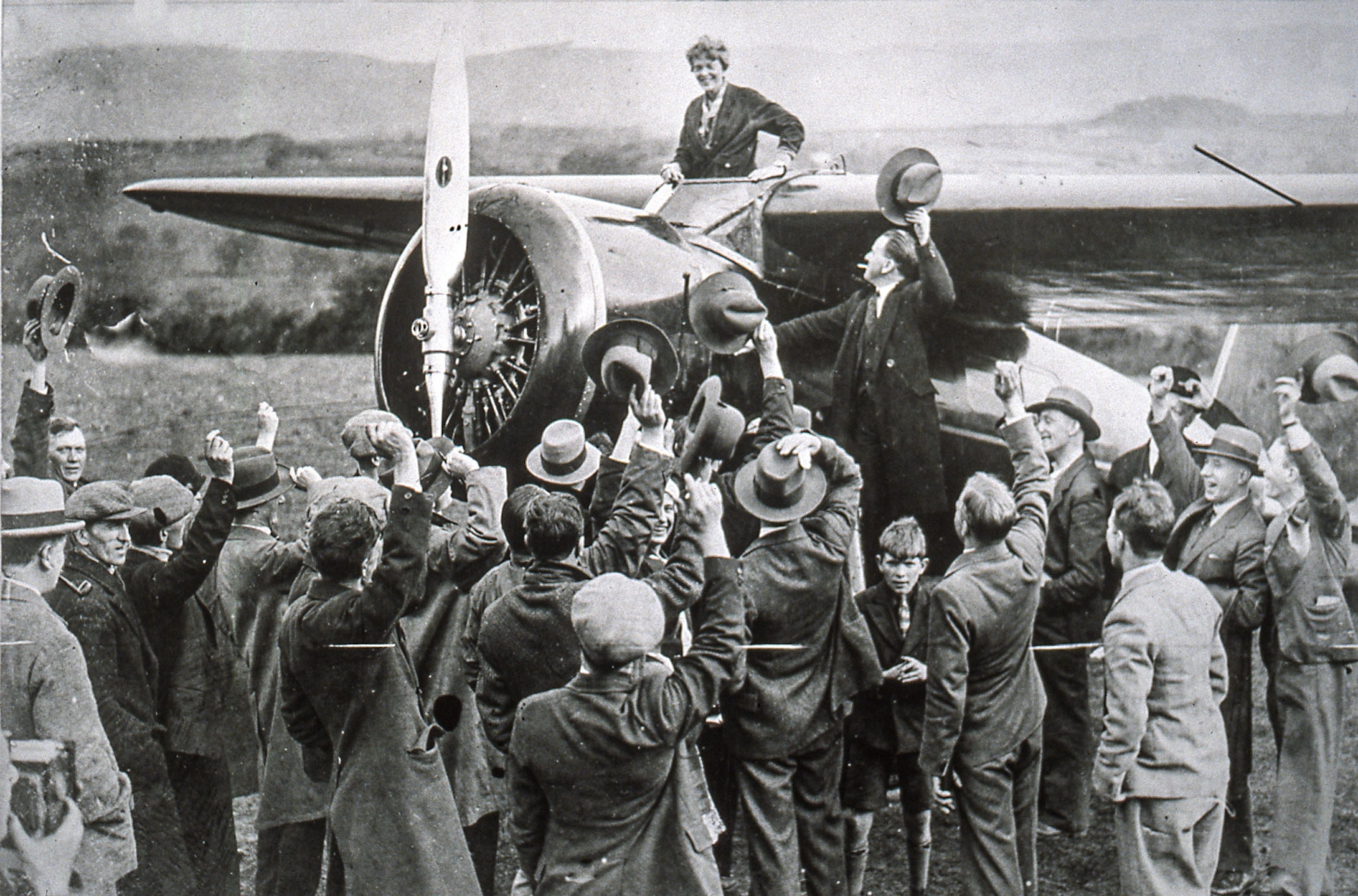
“Lady Lindy”—so known for her resemblance to Charles Lindbergh, the biggest aviation celebrity of the age—was just getting started. After marrying publicist George Palmer Putnam, Earhart began emulating Lindbergh’s signature achievements, starting with being the first woman pilot to complete a nonstop flight solo across the Atlantic Ocean in 1932.
In the decade that followed, she added more firsts to the list, becoming the first person to solo flight across the Pacific Ocean. Buoyed by her successes, she began planning the most ambitious flight ever undertaken by a woman to date—a solo flight around the world.
The mystery of Amelia Earhart’s disappearance
Earhart’s trusty Lockheed Electra took off from Oakland, California on June 1, 1937, to international fanfare. Fans tracked Earhart and navigator Fred Noonan as they touched down to refuel at locations around the world. But after departing Lae, New Guinea, for one of the final stretches of the journey on June 29, they disappeared. Earhart, Noonan, and the plane were never seen again.

An unsuccessful manhunt turned up no plane and no remains. But though Earhart was pronounced dead a few weeks after her disappearance, searches for her final resting place—and more information about the doomed flight—have continued ever since.
Theories abound on what happened to Amelia Earhart and her navigator. Were they captured by the Japanese and executed as suspected spies? Did they run out of fuel and crash into the Pacific, leaving the wreckage of their plane at the ocean floor? Or did they spend their last days as castaways on a remote Pacific island? The answer is still unclear. Generations of explorers have searched and recently used modern technology like sonar and autonomous underwater vehicles to find her plane.
(Has Amelia Earhart’s plane really been found?)
Earhart’s influence on women in aviation
Earhart’s fate will likely never be known. But her significance as a female aviation pioneer live on. Earhart not only used her celebrity to lobby for aviation legislation, but she paved the way for public acceptance of independent, adventurous women. She was far from the first accomplished female pilot. But her worldwide fame helped other women get their start in aeronautics and technology, blazing a trail for women in aviation and elsewhere.
Women are still underrepresented in aviation. According to the International Civil Aviation Organization, just 4.9 percent of pilots, air traffic controllers, and airplane maintenance technicians were women in 2023. But that number grows every year—thanks in part to the trailblazing woman who helped the world take flight.
(Meet the women who risked everything to be the first to fly.)
“All kinds of minds…are trying to work out theoretical details of efficient flight,” Earhart wrote in 1932. “That women will share in these endeavors, even more than they have in the past, is my wish—and prophecy.”
Comments
Post a Comment