The man who died searching for the Lost City of Z
In 1925, explorer and surveyor Percy Fawcett disappeared in the Amazon basin looking for an ancient civilization. Although he was inspired by questionable sources, we now know if his search was in vain.

When the Spanish first ventured into the Amazon Basin in the 1540s, they recorded Indigenous accounts of a lost city of fantastic wealth that they called El Dorado (“the golden”). Over the centuries, many vain attempts were made to locate a lost civilization in the Amazon rainforest.
The last significant attempt to find such a culture was undertaken by British explorer Percy Fawcett. Between 1906 and 1924, Fawcett made seven expeditions across the Amazon Basin, concluding with his doomed quest to find the city he called Z. Fawcett was inspired by his extensive reading of historical sources, including a mysterious document known as Manuscript 512.
A man of extraordinary mental and physical stamina, Fawcett was working at a time when the Amazon region was still largely undocumented by Europeans who sought to explore its jungles and waterways, seeking ancient cities and riches. His disappearance during his search for Z in 1925, in the Mato Grosso region of Brazil, continues to intrigue writers and filmmakers.
(The true story of the 'lost city' made famous by Indiana Jones.)
Yearning to explore
Percy Harrison Fawcett was born in 1867 in Torquay, Devon, the English county that had produced many famous explorers and mariners, including Francis Drake and Walter Raleigh.
The son of an aristocrat who had lost his fortune, Fawcett described his childhood as lacking in affection. At age 19, he was commissioned as a lieutenant in the Royal Artillery and sent to outposts of the British Empire.

In 1901, Fawcett joined the Royal Geographical Society of London and traveled to Africa as a surveyor in the service of the British state, tasked with gathering military intelligence. In 1906, he was commissioned by the society to lead an expedition to the Amazon.
Arriving in South America was the moment his whole life changed. Setting out from La Paz to map the vast territory on the borderlands of Bolivia and Brazil, Fawcett often faced hostility from Indigenous peoples angered by rubber barons, who had invaded their lands to extract rubber for use in car and train manufacturing.
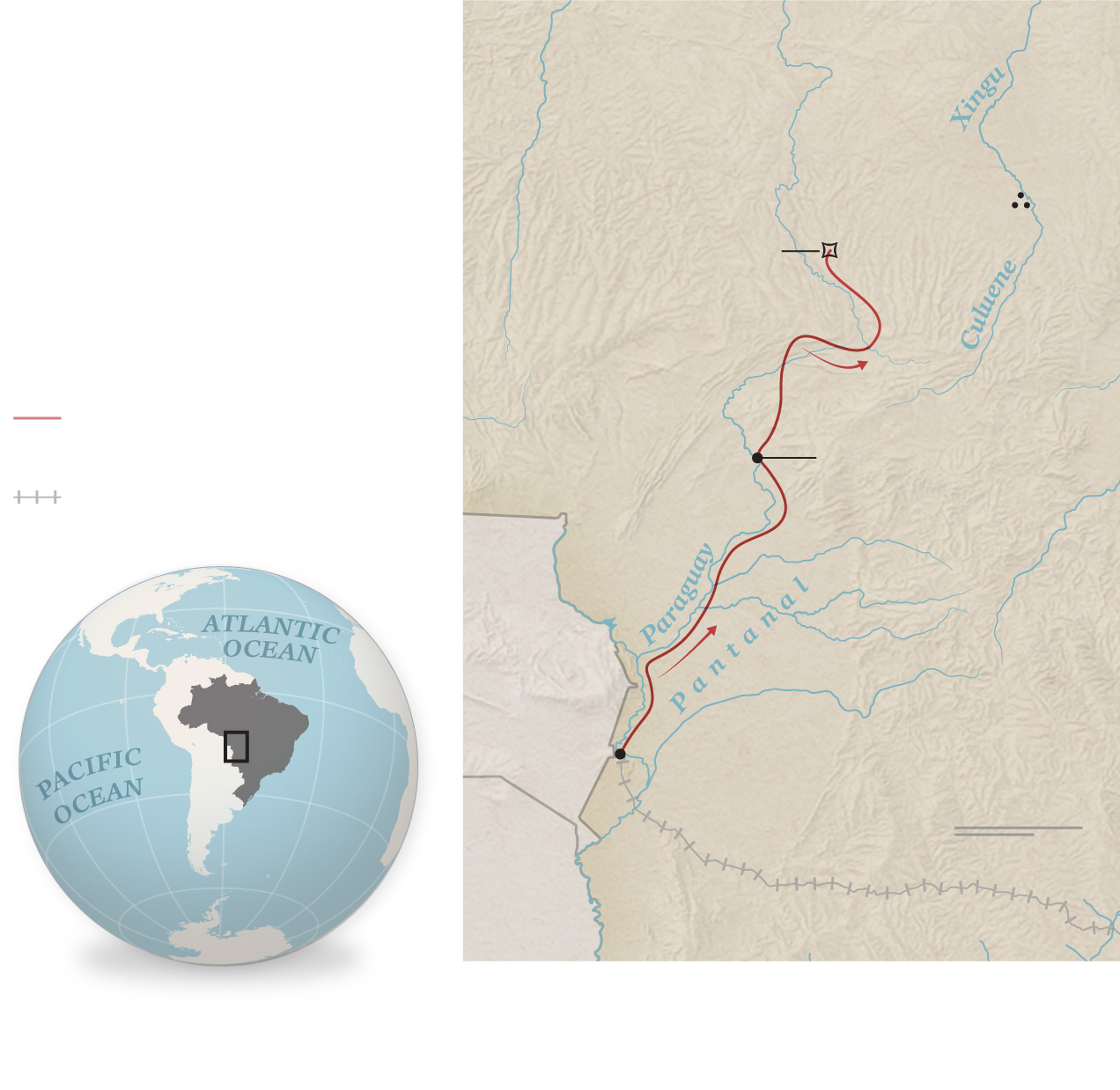
Fawcett’s last journey
After completing seven South
American mapping expeditions
for Britain’s Royal Geographical
Society, Percy Fawcett returned
in 1925 to search for the lost city
of Z. He left from the same
camp where his horse died on
a previous expedition and was
never heard from again.
AMAZON BASIN
Possible destination
Kuhikugu
Dead Horse
Camp
May 29, 1925
Fawcett writes a
letter to his wife and
continues his search.
MATO GROSSO
Plateau
Route of Fawcett’s
1925 expedition
Cuiabá
April 1925
Expedition team sets off into the jungle.
Railroad
Brazil
Bolivia
BRAZIL
MAP
Area
Corumbá
February 1925
Arrival by train
SOUTH
AMERICA
100 mi
100 km
Para.
Present-day boundaries and rivers are shown.
NGM Staff.
Source: David Grann, The Lost City of Z: A Tale of Deadly Obsession in the Amazon
F
For nearly a decade he roamed the Amazon Basin, often the first European to record geographical features such as waterfalls. His writing gives a sense of the awe he experienced:
Above us rose the Ricardo Franco hills, flat topped and mysterious, their flanks scarred by deep quebradas [ravines]. They stood like a lost world, forested to their tops, and the imagination could picture the last vestiges of an age long vanished.
The outbreak of World War I interrupted this rich period of exploration, forcing him to return to Europe. Although in his 50s, Fawcett was in peak physical condition, and he proved to be an outstanding soldier.
(These other explorers disappeared into thin air. Will we ever know the truth?)
A mysterious manuscript
Fawcett could not shake off the allure of South America, however. So, when the war ended, he returned to Brazil, where he would pursue an idea that led him to his last great adventures and, ultimately, his mysterious death.
Although Fawcett often relied on racist tropes and ideas when he wrote of Brazil’s Indigenous peoples, he also made great efforts to understand their customs and languages.
He lamented the effects of colonialist greed on these societies and became convinced that Spanish and Portuguese accounts from the 16th and 17th centuries of complex civilizations in the rainforest may have had merit. Such accounts mention “very large settlements” as well as “fine roadways in the interior.”
One document in particular fascinated Fawcett. Known as Manuscript 512 and written in Portuguese, it is purportedly an account by adventurers and fortune hunters. In 1753, in search of precious metals, the adventurers found a ruined city boasting monumental buildings, roads, and a plaza, in “each corner of which is a spire, in the style of the Romans.”
Mystery manuscript
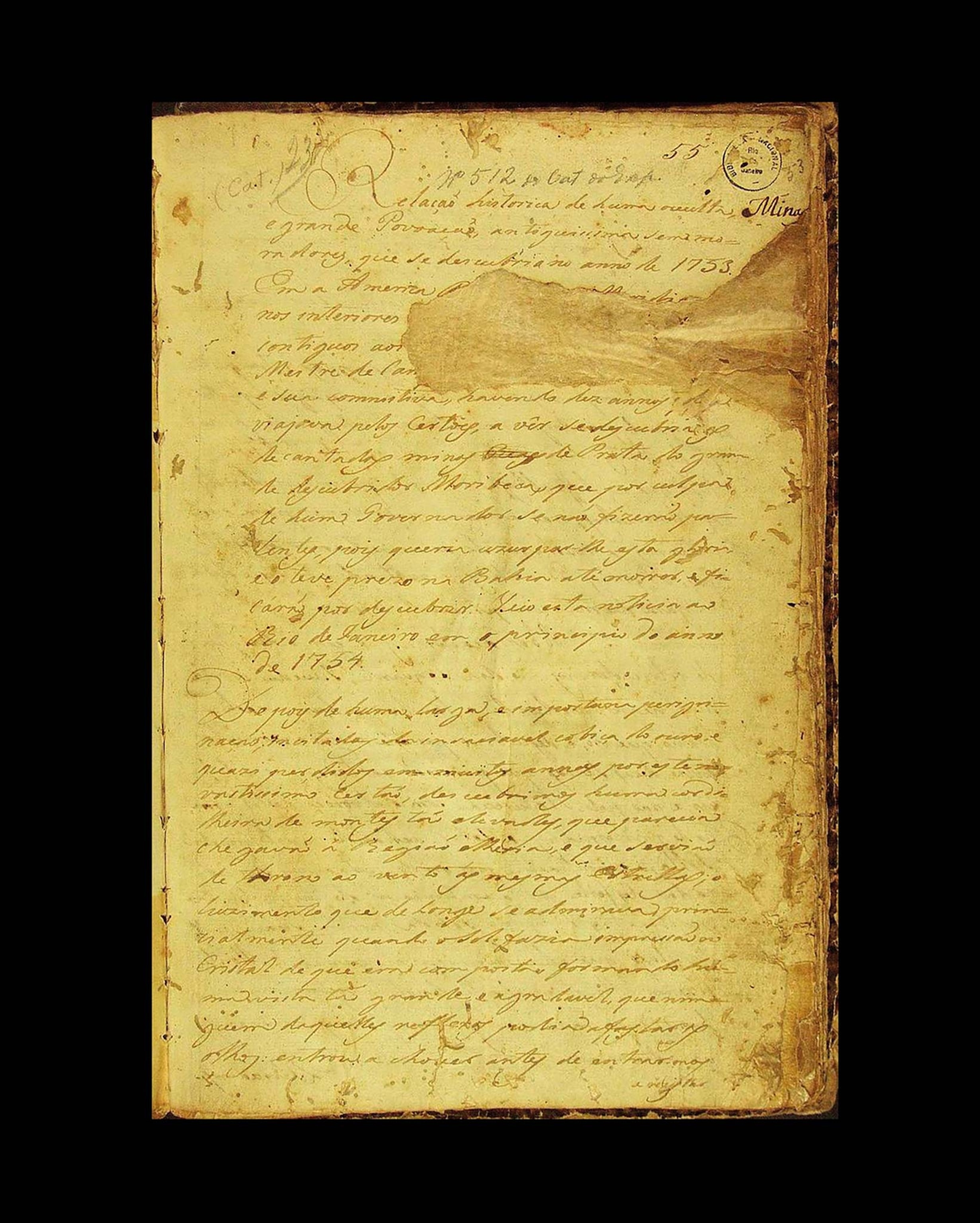
Scholars are divided about the manuscript’s authenticity. Skeptics consider it a forgery. Brazil achieved independence from Portugal in 1822. It would have been useful for a new, insecure republic to “discover” a document that described ancient civilizations in its territory—akin to the great Maya sites in Central America. Many at the time, however, accepted the manuscript’s authenticity, including Fawcett, already convinced that early accounts of complex civilizations in the rainforest were accurate. He became obsessed with finding such a place.
In search of Z
Although Fawcett was inspired by Manuscript 512’s claims, he never intended to find the city it described. The settlement in that document lies, supposedly, in Brazil’s northeast. Citing other sources (which he did not name), Fawcett became convinced that a lost civilization existed in the wild, central-western region of Mato Grosso. He named the city Z.
In April 1925, Fawcett set out from Cuiabá to find it, accompanied by his eldest son, Jack, and his son’s best friend, Raleigh Rimell. The last news from them was in a letter Fawcett sent to his wife: “We shall disappear from civilization until next year. Imagine us ... in forests so far untrodden by civilised man.”
And then they really did disappear. Were they killed by animals or people? Several expeditions were launched in an attempt to clarify what happened, including one headed by Peter Fleming, brother of the James Bond creator Ian Fleming. Many of these ventures also ended in tragedy. And none shed any light on what happened to Fawcett.
(This Arctic murder mystery remains unsolved after 150 years.)
In 1952, anthropologist Orlando Villas-Bôas announced he had found the bones of the explorer and that Kalapalo Indians had confessed to killing him. Later forensic analysis showed the remains did not belong to Fawcett.

Fawcett’s story has had an enduring cultural impact. He is one of the inspirations for the character Indiana Jones. (The Walt Disney Company is a majority owner of National Geographic Media.) The English explorer was also the subject of David Grann’s The Lost City of Z: A Tale of Deadly Obsession in the Amazon, the basis for a 2016 feature film. In his book, Grann quotes Kalapalo Indians, who insist they had not killed Fawcett. They had seen the smoke from Fawcett’s camp for a few days until it stopped. They say he likely died at the hands of “hostile” people in territory to the east.
(Did Indiana Jones help or hurt archaeology?)
Although the mystery of his last days may never be fully resolved, Fawcett’s quest for a lost city may be at an end. In the decades since his disappearance, exploration of northeastern Mato Grosso has uncovered the remains of large urban settlements, now located in Xingu Indigenous Park. Named Kuhikugu, the complex includes remnants of streets, bridges, and large squares. Modern lidar scans further suggest that between 1,500 and 400 years ago, this part of the Amazon was indeed the site of a large settlement. While Z’s exact identity and location are still a mystery, Fawcett’s hunch about a hidden ancient city in the region seems to have been correct.
Comments
Post a Comment