The search for enslaved ancestors often hits a wall. Can new tools break it?
A writer's search for her Jamaican ancestors reveals how the largest efforts yet to digitize and connect slavery-era records are transforming what descendants can learn about their ancestors.
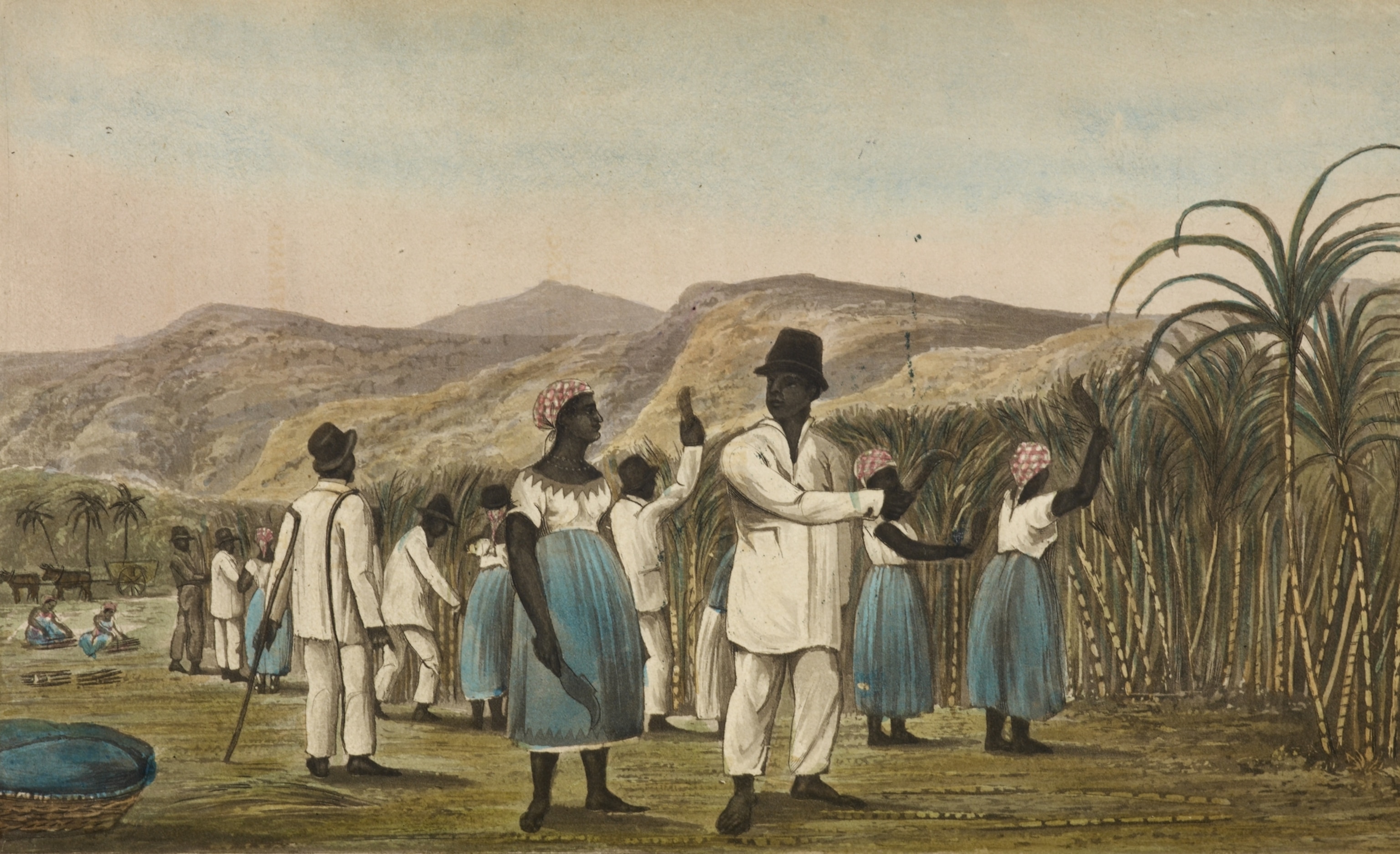
My father left Jamaica at fifteen with little more than fragments of family history: names, places, and stories that didn’t stretch far beyond the island. For years, we’ve tried to trace our lineage further back, searching for the African country our ancestors were taken from. Like many descendants of enslaved people in the Caribbean, we’ve encountered the same barrier: the records were never designed to preserve who our ancestors were.
So this year, I tried. I entered what little I had: a parish, a plantation region, a surname that probably wasn’t original. What came back was not an ancestor. It was a list of first names—no surnames, no fathers, women listed alongside children who disappeared in the next entry. For many Caribbean families, this is where the search stops.
That dead end is beginning to shift. What’s changing now isn’t the past. It’s how historians are learning to read it. Only recently have digitized archives, AI-assisted transcription, and large collaborative databases made it possible to connect millions of historical records at this scale. The result isn’t a breakthrough so much as a widening of what’s recoverable—and a clearer understanding of what remains beyond the archive.
Historians are learning to read the archive differently
The most significant recent development came this spring when University College London (UCL)’s Centre for the Study of the Legacies of British Slavery secured a £450,000 ($601,812 USD) grant to fund Valuable Lives: Black Unfreedom and the collapse of Slavery in Jamaica. The project aims to create a publicly accessible database of every person enslaved in the British Caribbean between 1817 and 1832.
Developed with England’s National Archives and Ancestry.com, the free, searchable database will launch in September 2026. Keith McClelland, a founder of the UCL Legacies project, calls the underlying slave registers “effectively censuses, designed to make the population visible to the [British] state.” Valuable Lives aims to make that same population visible to descendants—for free and on their own terms.
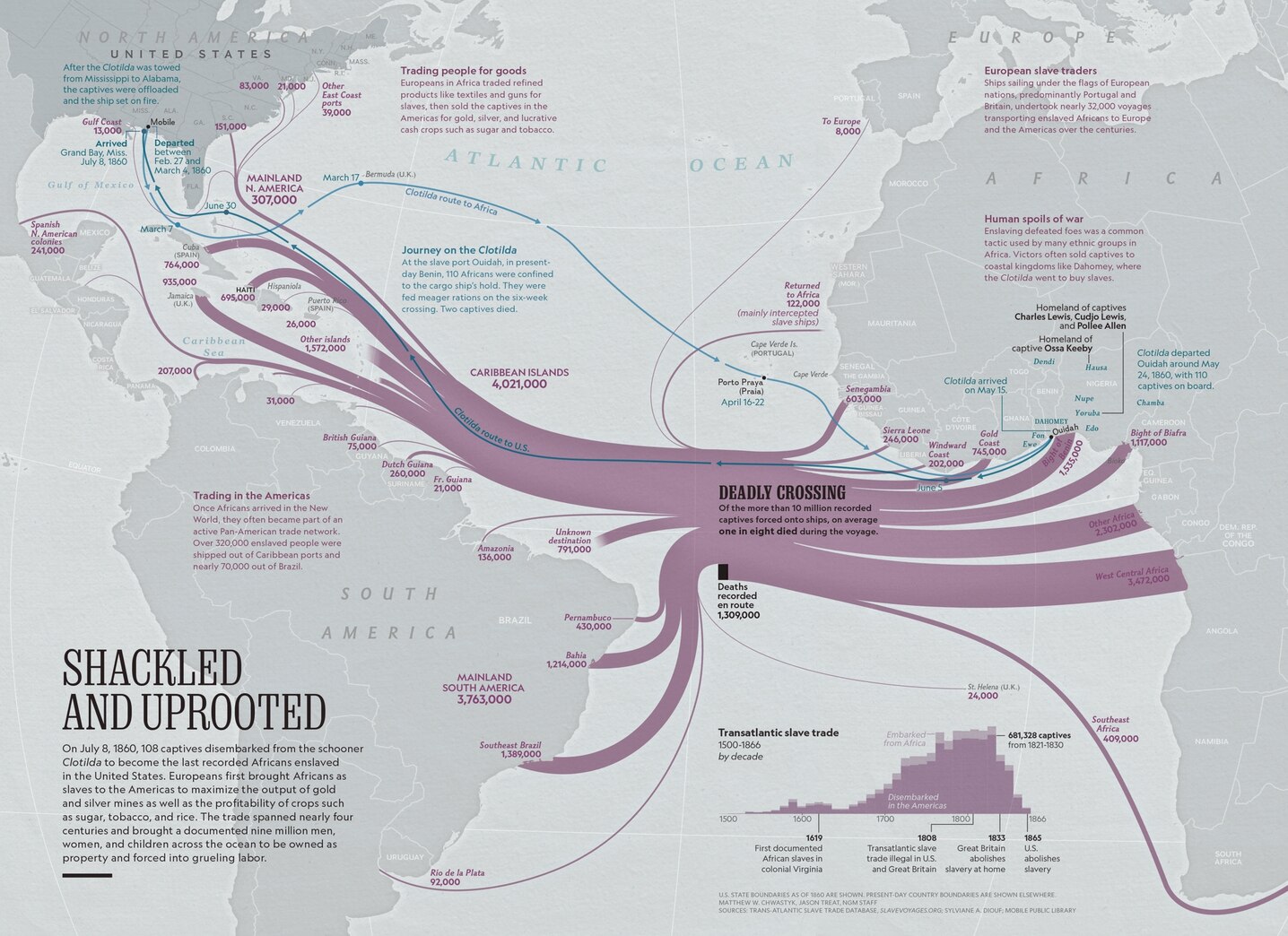
A map traces the routes of ships involved in the transatlantic slave trade, which forcibly transported millions of Africans to the Americas and the Caribbean.Matthew W. Chwastyk, Jason Treat, NGM Staff Sources: Trans-Atlantic Slave Trade Database.jpg, SlaveVoyages.org; Sylviane A. Diouf; Mobile Public Library
Yet the project also reveals the archive’s central paradox: some of the most extensive surviving records of slavery were never created to preserve the identities descendants now hope to recover. Births were listed alongside mothers but without paternal identification; some entries reflect the realities of sexual violence without naming it directly. Deaths were marked with little more than a line, if at all.
The gaps are only part of the challenge. Even when people appear in the records, following them from one document to the next can be surprisingly difficult. Enslaved people often used multiple names simultaneously––an owner-assigned name in formal records and a community name outside them. As a result, matching algorithms can struggle to recognize when two documents refer to the same person.
For example, Letitia Smith, traced by the UCL team through Port Royal registers, appears with both the name her enslaver gave her and a baptismal name. Documents reveal her sale in 1826 at age 22 to a William Kuckahn and allow researchers to follow her family into the post-slavery period.
(A new tool hopes to uncover the lost ancestry of enslaved African Americans.)
By linking entries across multiple registers, McClelland explains, historians can trace individuals over time: someone listed one year may reappear later with a slightly different name, a different plantation, or an updated age. “We’re trying to move from counting people to understanding something about their lives,” he says.
Even so, the limits remain structural. The registers begin only in 1817, when Britain required slaveholders to record enslaved people as part of its post-abolition oversight of the slave trade and covering just the final 15 years of British Caribbean slavery. Paternal lines are almost entirely absent. “It will be possible to do more than before,” McClelland says, “but for the vast majority of the enslaved population, full genealogies will remain out of reach.”
Finding lives the archive wasn’t built to preserve
For Shauna Sweeney, an assistant professor at the University of Toronto who specializes in gender, economy, and slavery in the Caribbean, the challenge is not only what the archive contains but how historians have learned to search it. Sweeney, who co-edited the Social Text special issue The Question of Recovery: Slavery, Freedom, and the Archive, argues that formal historical methods have undervalued knowledge that survived outside institutions. “As historians, there is something we can learn from genealogists,” she says. “We could pay more attention to oral histories in our research.”
Vincent Brown, a history professor at Harvard University, is among those taking that broader approach. His project twoplantations.org reconstructs the lives of 431 enslaved people across seven multigenerational families in Jamaica and Virginia, drawing on four decades of archival research by historian Richard S. Dunn. It is among the most detailed genealogical reconstructions of enslaved family life yet produced. Brown has written that “only by wrestling imaginatively with difficult archival problems can we hope to find new avenues for pondering and representing history’s most painful and vexing subjects.”
The same impulse—to connect scattered pieces of evidence—is increasingly supported by digital tools. Handwritten Text Recognition technology can make millions of historical documents searchable in seconds, while AI can rapidly identify names, dates, places, and other details across millions of documents. But these systems perform best on consistent handwriting and stable naming conventions—precisely the conditions least likely to exist in records of enslaved people. AI can help historians connect more pieces of the archive; it cannot restore information that was never recorded.
(10 million enslaved Americans' names are missing from history. AI is helping identify them.)
Those methods are now being adopted. The 10 Million Names project, launched in 2023 by American Ancestors in collaboration with FamilySearch, is the largest-scale collaboration between professional historians and genealogists in the field. Unlike conventional genealogical research, it works in reverse, starting in the past and moving toward the present, drawing on AI-assisted transcription and oral history sources including Federal Writers’ Project narratives collected from formerly enslaved people in the 1930s.
That approach allows researchers to reconstruct enslaved families forward through time rather than relying on descendants to work backward from incomplete family records.
What survives outside the archive
When I searched for traces of my own family, I found the archive’s limits firsthand. The registers contained dozens of first names that might (or might not) have belonged to my family’s plantation region. Without a surname or parish record, there was no thread to follow. The registers sometimes preserve maternal lines, but they led only to another boundary: the generation I’m searching for predates 1817, where the systematic record begins. For Caribbean descendants, the question of African origins remains almost entirely beyond the reach of documentary evidence. The registers do not go back that far. Nothing does.
Yet archives are not the only places where history survives. Sonjah Stanley Niaah, a cultural theorist at Jamaica’s University of the West Indies, Mona, points to oral histories, ritual practices, and cultural transmission as forms of historical knowledge that have long existed outside written records. “What is lost,” she says, “is direct, accessible, collective, and individual personhood.”
(This writer just traced his enslaved ancestors all the way to Africa. Here’s how.)
Even as the archive expands, its boundaries are becoming clearer. Some connections can now be identified with greater precision, such as movement between plantations, maternal relationships, population patterns. Others, including origins in Africa and full family lineages, remain largely unrecoverable.
As Stanley Niaah puts it, “identity is what anchors you in the world.” Even when the archive falls silent, that anchor remains, carried, as it always has been, by the things that were never written down. For families like mine, that is where the search continues.
Increasingly, written records and oral traditions are being understood not as competing histories but as complementary ones.
Comments
Post a Comment