King Tut, facts and information
- HISTORY & CULTURE
Ever since his glittering tomb was discovered a hundred years ago, King Tut has been surrounded by mystery and fascination. Here’s what you need to know.

King Tut, or Tutankhamun, is one of the most famous rulers who ever lived thanks to the 1922 discovery of the pharaoh’s tomb in Egypt’s Valley of the Kings. The find stirred the imaginations of millions who were fascinated by the boy king’s golden-masked mummy.
But what do we really know about King Tut? Although many details of his reign remain lost to time, historians have spent years trying to piece together the pharaoh’s life and legacy. Here’s what they’ve learned—and the biggest questions that remain.
King Tut’s rise to the throne
Born during ancient Egypt’s 18th Dynasty—which stretched from 1550 B.C. to 1295 B.C.—Tut began his life under a different name: Tutankhaten.
In the years before Tut rose to the throne, Egypt was going through a period of great upheaval. King Amenhotep IV, who is believed to be Tut’s father, had turned away from his culture’s many gods to worship a sun god called the Aten. In honor of the new deity, he changed his own name to Akhenaten and named his son Tutankhaten, meaning “living image of Aten.”
But around 1336 B.C., King Akhenaten died after about 17 years on the throne—and nine-year-old Tut ascended to power. The boy king restored the old ways of the kingdom, bringing back its many gods and opening new temples.
(See the enduring power of King Tut as never before.)
The son of Akhenaten also changed his name to Tutankhamun, which meant the “living image of Amun,” the Egyptian god of the air. He also took on the throne name, Nebkheperure, which was a nod to the old sun god Re, or Ra.
He married a woman named Ankhesenamun, a daughter of Akhenaten and Queen Nefertiti. While the couple are not thought to have left any surviving children, two mummified fetuses found in Tut’s intact tomb were likely their stillborn daughters.
(Learn about King Tut’s family secrets)
Tutankhamun’s tomb
The rest of Tut’s short reign was fairly unremarkable. Ruling for only about nine years, Tutankhamun was one of the lesser known pharaohs of his time.
Some scholars theorize that royal advisers and priests may have even used the boy king as a puppet to reclaim power for themselves.
Others suggest that Tut’s successors removed his name from monuments and records because of his association with his reviled father, Akhenaten.

But there was one upside to that erasure: While most of the tombs in the Valley of the Kings were looted over the centuries that followed, Tut’s royal tomb was left relatively unspoiled.
When its treasures were finally brought to light, they inspired modern investigations into the young king’s life and what it reveals about the time of the ancient Egyptians.
(How was King Tut’s tomb found? Through grit and luck.)
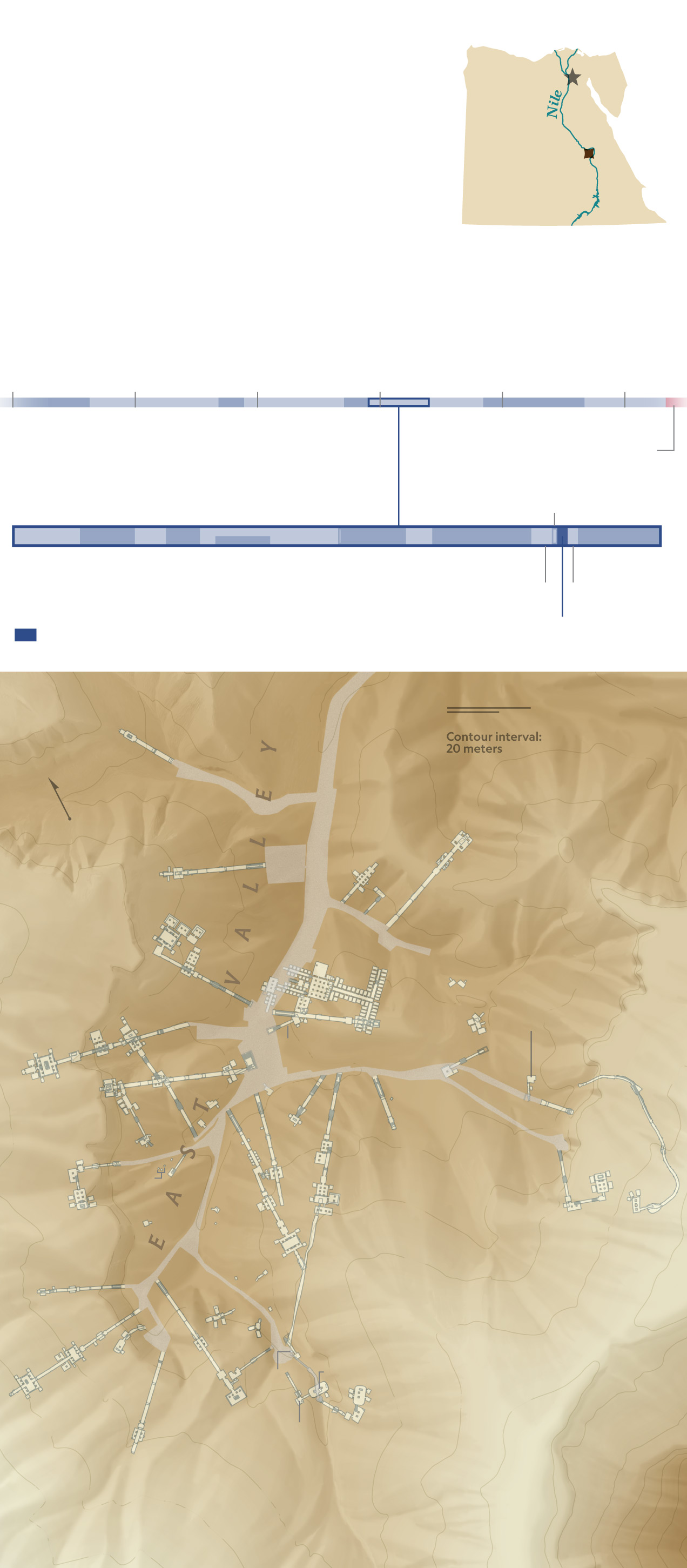
Afterlife in the Pharaohs’ Valley
Egypt’s later pharaohs were believed to begin their journey to the afterlife in the Valley of the Kings, just west of the religious hub of Thebes. Most of the valley’s 64 known tombs were looted over the centuries. But in 1922, British archaeologist Howard Carter made an astonishing discovery when he opened tomb KV 62: the treasures and mummified remains of the 18th dynasty pharaoh Tutankhamun.
Cairo
EGYPT
Valley of
the Kings
Minor King in an Epic Dynasty
Tutankhamun ruled for about nine years and died young. He was one of the lesser known pharaohs of his era, but the discovery of his relatively unspoiled tomb elevated King Tut’s modern stature.
18th Dynasty
1550-1295
3000
B.C.
2500
B.C.
1000
B.C.
2000
B.C.
1500
B.C.
500
B.C.
Late Period
664-332
Early
Dynastic
3000-2686
Old
Kingdom
2686-2160
Middle
Kingdom
2055-1650
New
Kingdom
1550-1069
Second
Intermediate
Period
1650-1550
Third
Intermediate
Period
1069-664
First
Intermediate
Period
2160-2055
Greco-Roman
332 B.C.-A.D. 395
Ahmose
Thutmose I
Thutmose IV
Thutmose III
Smenkhkare
1504-1492
1550-1525
1479-1425
1400-1390
Amenhotep I
Thutmose II
Queen
Hatshepsut
Amenhotep II
Amenhotep III
Horemheb
1492-1479
1525-1504
1427-1400
1390-1352
1323-1295
1473-1458
Akhenaten
Ay
1352-1336
1327-1323
Tutankhamun
Entombed
18th Dynasty official
Tomb number
KV 5
1336-1327
200 ft
160
40 m
220
160
Contour interval:
20 meters
180
KV 1
180
N
180
Yuya
and
Tuyu
KV 2
KV 3
KV 46
200
KV 4
180
200
220
KV 5
KV 45
KV 44
KV 7
200
Horemheb
KV 28
180
Sit-Ra
240
KV 8
KV 57
KV 60
KV 6
KV 55
KV 27
Akhenaten; Smenkhkare
Tutankhamun
KV 9
KV 21
KV 62
260
KV 63
KV 16
KV 56
KV 54
KV 17
KV 12
KV 19
KV 18
Amenhotep II;
Younger Lady
KV 58
200
KV 10
KV 48
KV 49
KV 50,51,52
KV 11
KV 20
KV 35
Thutmose IV
220
KV 61
KV 43
Thutmose I;
Hatshepsut
Maiherpri
KV 29
KV 36
240
KV 40
KV 13
KV 26
KV 47
KV 30
KV 59
200
260
KV 31
KV 14
Tiaa
KV 37
220
KV 32
KV 33
KV F
Thutmose I
KV 38
Thutmose III
280
KV 15
KV 34
260
Hatshepsut-
Meryetre
KV 42
Matthew W. Chwastyk, NGM Staff
Sources: Theban Mapping Project;
The Oxford history of Ancient Egypt,
Oxford University Press
(How was King Tut’s tomb found? Through grit and luck.)
King Tut’s mysterious death and lasting fame
One of the puzzles that has most vexed historians and scientists alike is how King Tut died.
Theories have abounded ever since British archaeologist Howard Carter discovered Tut’s tomb in 1922. Some suspect that he was murdered or died from malaria or another devastating disease.
Others have hypothesized that Tut’s chest—which is missing ribs and a sternum—might have been crushed in an accident or fall from his chariot.
Still others argue that he likely died an invalid, pointing to evidence of a clubfoot and canes that he may have used to walk.
(Discover King Tut's 5,000 treasures, by the numbers.)


One thing scholars do know is that Tut was young when he died—still a teenager by most accounts—and his death was unexpected.
Tut’s final resting place was in fact an unfinished burial chamber intended for some other courtier, and evidence suggests that it was prepared for the king’s body in a hurry.
(The last missing tomb from this wealthy Egyptian dynasty has been found)
It’s unclear whether we will ever fully understand the life of Tutankhamen, the boy king. But centuries after his short reign, King Tut’s memory continues to captivate the world, not just at the Valley of the Kings, a UNESCO World Heritage site since 1979. Artifacts for King Tutankhamun exhibits attract attention to the newly opened Grand Egyptian Museum.
5 fascinating facts about King Tut
King Tut was buried with golden sandals bearing images of his enemies, indicating that he “trampled” has foes wherever he went.Scientists using digital imaging and DNA testing found that King Tut had a broken leg and likely died from an infection or a disease like malaria.
King Tut was buried in a golden coffin nested inside two other coffins.
Although King Tut’s tomb wasn’t ransacked like others in the Valley of the Kings, it had been broken into before. Only small items were stolen and ancient officials resealed the tomb.
King Tut was buried with more than 5,000 treasures, which took Howard Carter and his team 10 years to catalog.
Comments
Post a Comment